

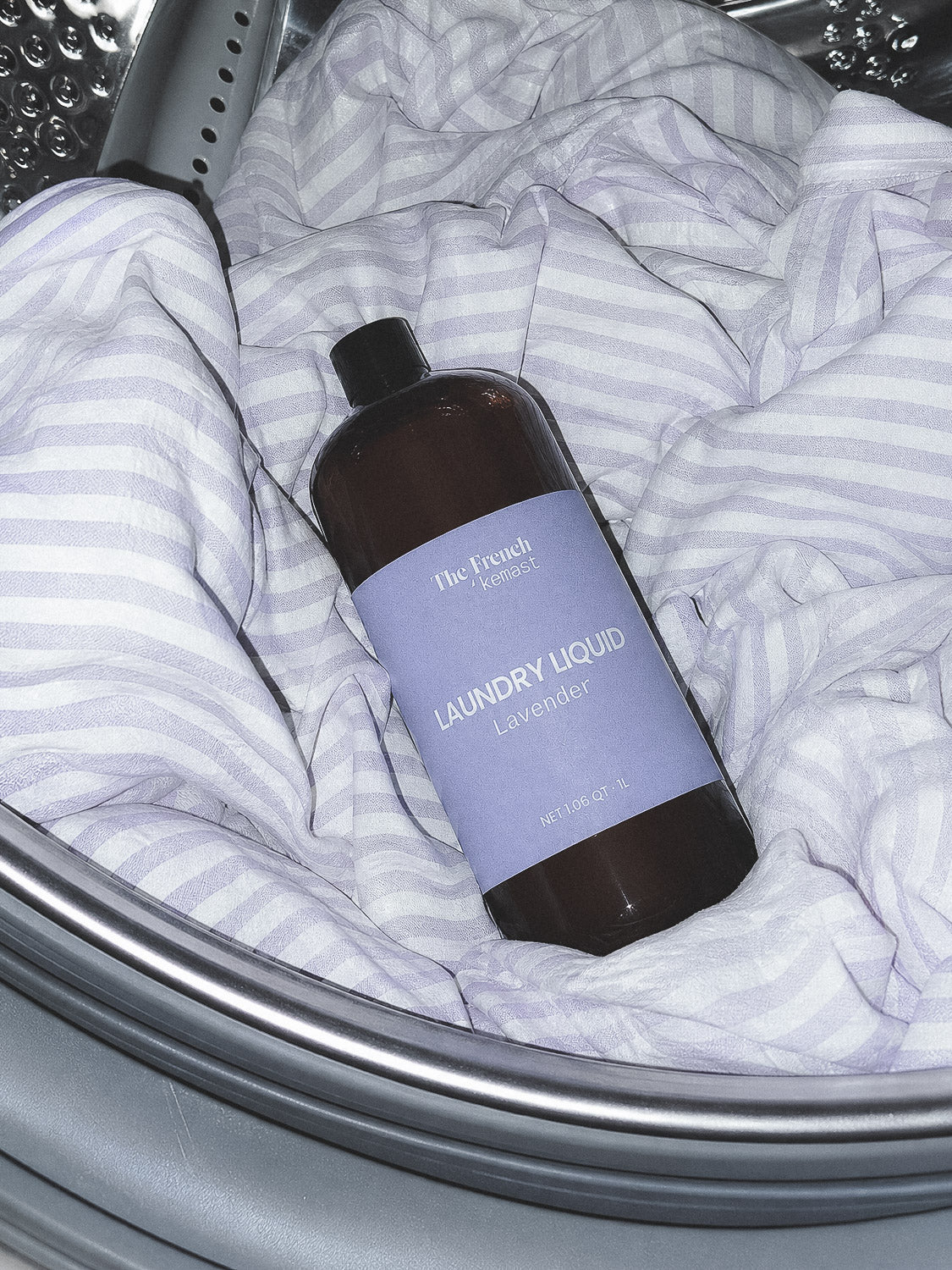
Almost certainly less than you are using now. Overdosing is the most common laundry mistake there is, encouraged by oversized caps, generous pouring, and the intuition that more product means cleaner clothes. The intuition is wrong, and the evidence is probably already in your laundry basket.
Why more detergent does not mean cleaner clothes
A wash cycle is a closed system: a fixed amount of water, a fixed amount of mechanical action, a fixed rinse. Detergent dosed correctly dissolves fully, does its work, and leaves with the rinse water. Detergent dosed beyond what the water can rinse away stays behind, in the fabric and in the machine.
The signs of chronic overdosing are familiar enough that most households will recognize at least one. Towels that feel stiff or scratchy and absorb poorly. Dark clothes with faint white streaks. Fabric that smells musty despite being freshly washed, because residue in the fibers and the machine feeds odor-causing buildup. Skin irritation with no obvious cause, since residue sits against skin all day. A washing machine drawer or drum gasket coated in gray film. None of these means your detergent is bad. They mean there is too much of it staying behind.
Excess suds cause a second, less visible problem: they cushion the mechanical action of the drum. Clothes clean partly by rubbing against each other in the wash; a foam-filled drum rubs less. Past the correct dose, more detergent can actually wash worse.
The dose depends on three things
There is no single correct amount, but there are only three variables, and you can read all of them in a minute.
Your water. Hardness is the biggest factor most people never account for. Hard water contains minerals that consume part of the detergent before any cleaning happens, so hard-water households genuinely need more, and soft-water households need noticeably less. If you do not know your water, your utility's annual quality report says, or a test strip costs very little. As a rough sign: if soap lathers instantly and abundantly at your sink, your water is soft.
Your load. Dose scales with how much fabric is in the drum and how dirty it actually is. Lightly worn office clothes and a toddler's garden afternoon are different problems. Most everyday loads are closer to lightly soiled than the cap assumes.
Your machine. High-efficiency machines, which include nearly all front loaders and many modern top loaders, use far less water than older machines. Less water means less rinsing capacity, which means correct dosing matters more, not less. If your machine is HE, treat the lower end of any recommendation as your starting point.
A practical method
Start from the manufacturer's dose for a normal load in medium-hard water, then run a simple experiment: reduce by roughly a quarter and watch results for two weeks. If clothes come out clean and fresh, stay there, or step down once more. The correct dose is the smallest amount that reliably gives you clean laundry. Almost everyone who runs this experiment lands below where they started.
Two habits make any dose work better. Measure, with the cap line or a marked cup, rather than pouring by eye; eye-pouring drifts upward over months. And load the drum properly: a fist's width of free space at the top gives clothes room to move, which is free cleaning power no detergent replaces.
For concentrated detergents, respect the smallness of the stated dose even when it looks implausible. Concentration means the same cleaning agents in less liquid; dosing a concentrate like a conventional detergent can mean using two or three times the intended amount. Our own laundry liquids are dosed at 35 mL for a normal load, about two and a half tablespoons, and the 1 L bottle's count of roughly 28 loads assumes exactly that. If a bottle is emptying much faster than its stated load count, the cap is telling on you.
When you genuinely need more
Honesty requires the other direction too. Use the higher end of the dose for heavily soiled loads, for very hard water, and for large-capacity machines filled to their limit. Pre-treat localized stains directly rather than raising the dose for the whole load, which is both more effective and cheaper. And if underdosed laundry starts coming out dull or dingy over weeks, step back up; the goal is the minimum effective dose, not the minimum dose.
The reward for getting this right compounds quietly: clothes that last longer and feel softer, a machine that stays cleaner, fewer rewashes, and a bottle that lasts as long as the label said it would. In laundry, precision is the cheapest upgrade there is.
FAQ
How do I know if I am using too much laundry detergent?
Stiff towels, white streaks on dark fabric, musty smells on clean clothes, and film in the detergent drawer are the classic signs. If a bottle empties much faster than its stated number of loads, your dose has drifted upward.
How much detergent should I use in an HE washer?
Less than in a traditional machine, because HE washers use less water to rinse. Start at the low end of the label's recommendation and adjust only if results slip.
Does water hardness really change detergent dose?
Yes, substantially. Hard-water minerals consume detergent before it can clean, so hard water needs more product and soft water needs less. Knowing your hardness is the single most useful fact for dosing correctly.
Can too much detergent damage my washing machine?
Chronic overdosing leaves residue that builds up in the drum, gasket, and drawer, feeding odors and buildup that shorten the machine's cleanliness and freshness. Correct dosing plus an occasional hot maintenance wash keeps the machine clean.
Why do my clothes smell bad even after washing?
Usually residue, not insufficient soap: excess detergent and fabric softener build up in fibers and machine, holding moisture and odor. Reduce the dose, skip softener, run a hot empty cycle, and leave the door open between washes.
Sources
- American Cleaning Institute, guidance on high-efficiency washing and detergent dosing (cleaninginstitute.org)
- Appliance manufacturer HE dosing guidance (e.g., published HE washer care documentation)
- USGS, water hardness classification and regional hardness data (usgs.gov)


