Every bar of true soap ever made, from ancient Aleppo to a French workshop this morning, is the result of one chemical reaction between two things: a fat and an alkali. Everything else, the oils chosen, the temperatures, the waiting, is craft built around that single transformation.
This guide walks through the whole process: what saponification actually is, what cold process means and why small makers choose it, why a finished bar contains no lye even though lye is essential to making it, and how the same chemistry, adjusted, produces liquid soap. By the end, the ingredient list on any bar of soap should read like a recipe you understand.
The reaction: saponification
Oils and fats are made of triglycerides: three fatty acids attached to a glycerin backbone. When a triglyceride meets a strong alkali dissolved in water, the alkali breaks the fatty acids off the backbone and bonds with them. The result is two new substances. The fatty acid salts are soap. The freed backbone is glycerin.
That is the entire secret: oil plus alkali gives soap plus glycerin. The reaction is called saponification, from sapo, the Latin word for soap, and it has been exploited for at least two thousand years, long before anyone could write the equation.
The alkali determines the soap's physical form. Sodium hydroxide produces solid soap, the bar in your hand. Potassium hydroxide produces a soft paste that dissolves readily into liquid soap. Same reaction, different alkali, different product. This is why label names carry so much information: sodium olivate is a solid soap made from olive oil, potassium sunflowerate a liquid soap made from sunflower oil.
Where the lye goes
The question every soap maker gets: if soap is made with lye, is there lye in my soap?
In properly made soap, no. Sodium hydroxide and potassium hydroxide are reagents, not ingredients of the finished product. During saponification they are consumed: every molecule of alkali that reacts is transformed, bound into soap molecules that behave nothing like the caustic material they came from. Flour, eggs, and heat give you cake; oil, lye, and time give you soap. You would not describe a cake as containing raw eggs.
Makers guarantee this with a deliberate imbalance called superfatting: the recipe includes slightly more oil than the alkali can react with, typically a few percent. This margin ensures no unreacted alkali can remain, and it leaves a small amount of free oil in the finished bar, which contributes to mildness. It is one of the quiet parameters that separates one maker's bar from another's.
A short history, for context
Soap predates chemistry as a science by millennia. Babylonian tablets from around 2800 BCE describe boiling fats with ashes, which is saponification in its rawest form: wood ash is alkaline. Aleppo in Syria was making olive and laurel oil soap over a thousand years ago, and that knowledge traveled the Mediterranean west, taking root in Castile in Spain, whose olive oil soap gave its name to the castile soaps still sold today, and in Marseille.
Two later discoveries turned a craft into an industry. In the 1790s, the Leblanc process made soda ash cheap and abundant, freeing soap makers from wood ash and plant sources of alkali. In the nineteenth century, Michel Eugene Chevreul, a French chemist, worked out the actual chemistry of fats and saponification, explaining what soap makers had been doing by feel for centuries. It is a small point of pride that the science of soap, not just its craft, has a French chapter.
The twentieth century added the synthetic detergent, developed when wartime fat shortages pushed chemists toward petroleum feedstocks. Synthetics took over laundry almost completely and much of personal washing too. True soap never disappeared; it became the deliberate choice rather than the default, which is more or less where this story finds us.
The oils: what each one brings
Ask a soap maker about their recipe and they will not talk about the alkali, which is a commodity. They will talk about oils, because the fatty acid profile of each oil writes the character of the finished soap.
Olive oil, rich in oleic acid, produces a famously mild soap with a dense, creamy, modest lather. Bars with a high olive content are gentle enough to have carried the reputation of castile and Marseille traditions for centuries; their trade-off is a softer bar that rewards a long cure.
Sunflower oil, high in linoleic and oleic acid, behaves as olive's lighter cousin: mild, with a soft conditioned feel, and readily available from European fields, which is why it anchors our liquid formulas.
Coconut oil, dominated by lauric acid, is the opposite pole: it makes a hard bar with big, fast bubbles and strong cleansing power, assertive enough that few makers use it alone. Shea butter and cocoa butter add hardness and a creamy after-feel. Castor oil, in small doses, stabilizes lather.
A recipe is a balance across these axes: hardness, mildness, lather, longevity. Two bars listing nothing but saponified oils can feel entirely different in the shower because their makers weighted the balance differently. This is also why "olive oil soap" on a front label deserves the usual follow-up: the ingredient list, which states the oils in proportion order, tells you whether olive leads the recipe or merely appears in it.
Cold process: the patient method
Industrial soap and artisanal soap mostly differ not in chemistry but in process, and the process leaves fingerprints on the finished product.
In cold process, the maker mixes oils and alkali solution at low temperature, without external cooking. The mixture is blended until it thickens to what soap makers call trace, then poured into molds. Saponification happens slowly, driven by the reaction's own heat, over the following one to two days. The soap is then unmolded, cut, and, crucially, left alone.
The alternative at industrial scale is a hot, continuous process: the reaction is driven fast at high temperature, then the soap is typically washed with salt water to separate it from the glycerin, which is drawn off and sold separately to other industries. The resulting soap noodles are dried, blended with additives, and pressed into uniform bars.
Both methods make real soap. But the differences are not cosmetic. Cold process keeps all the glycerin created by the reaction inside the bar, where it acts as a humectant, a substance that attracts and holds moisture. Cold process also never subjects the oils to prolonged high heat, which matters when the recipe relies on delicate oils. And cold process preserves the maker's exact recipe in the final bar: what went into the mold is what you hold, transformed but not fractionated.
The trade-off is time, which brings us to curing.
Curing: why good soap waits
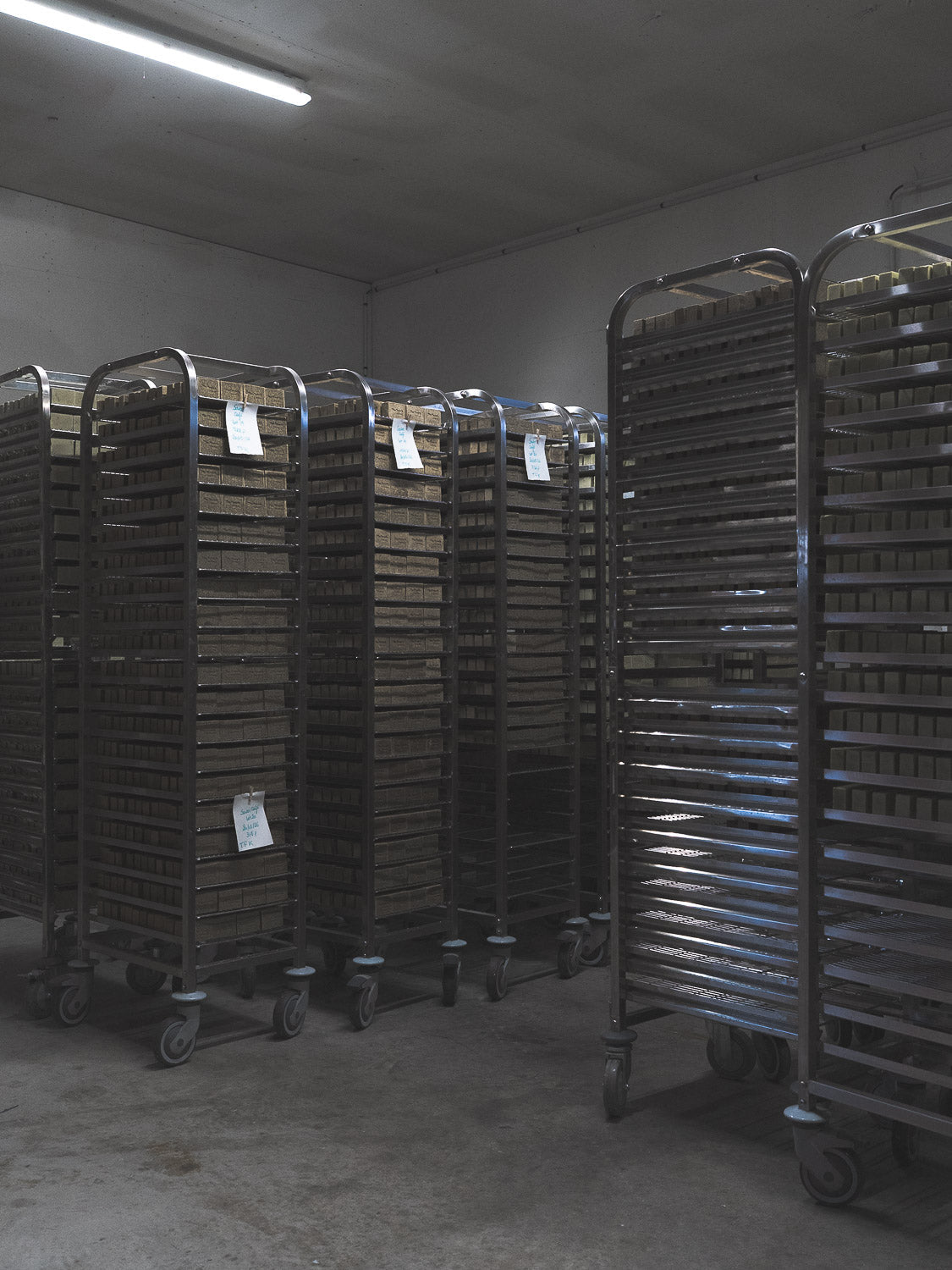
A cold process bar is chemically soap within about forty-eight hours, but it is not finished. For the next four to six weeks, the bars rest on racks in open air. Two things happen during this cure.
First, water evaporates. A fresh bar can be a fifth water by weight; as it dries, it hardens. A well-cured bar lasts dramatically longer in the shower than a fresh one, because a hard bar sheds less soap with each use.
Second, the last traces of the reaction complete and the crystalline structure of the soap settles, producing a milder bar with a creamier lather. Soap makers can identify a rushed bar by feel. Curing cannot be meaningfully accelerated without changing the product; it is bought with shelf space and patience, which is part of why genuine cold process soap remains a small-scale craft.
Liquid soap: the same craft, dissolved
Liquid soap is not solid soap melted down, and it is not detergent dyed to look wholesome. It is the same saponification performed with potassium hydroxide. The reaction yields a soft soap paste, which the maker then dissolves in water to the desired concentration and adjusts, for texture, and in scented versions, with essential oils.
The craft decisions transfer directly. Which oils: olive for mildness and a creamy, low lather; sunflower for a light feel and a clean rinse. How much superfat. What concentration. Whether to add anything at all beyond soap, water, and salt. Our body washes are exactly this: potassium sunflowerate and potassium olivate, the glycerin from their own saponification, water, and, depending on the variant, an essential oil. Reading that label after reading this guide, you can reconstruct the entire process from the ingredient names.
The French thread
France did not invent soap, but it industrialized rigor around it earlier than most. The soap tradition of Marseille, formalized by royal edict in 1688, imposed rules on what a soap of that name could contain: vegetable oils, and famously, requirements about purity and process. That regulatory instinct, the idea that a soap's identity is its recipe and method rather than its perfume, runs through French soapmaking to this day.
The modern French workshop inherits that lineage at human scale: kettles and molds rather than continuous lines, recipes counted in a handful of oils, curing racks doing slow work no machine replaces. Our soaps are made this way, in a French production facility, by people who can tell you the superfat percentage of every recipe from memory. We say this not as romance but as specification. In soap, tradition is not an aesthetic; it is a set of verifiable production choices.
Reading a bar of soap
Take any bar and apply this guide. Sodium olivate: olive oil, saponified, solid. Glycerin listed: either retained from the reaction or added back; in cold process, it was never removed. A named superfat oil such as plain olive or sunflower oil near the end of the list: mildness left in on purpose. An essential oil and its components: the scent, disclosed. Water: what remains of the cure.
Four or six lines that describe a process from kettle to curing rack. That is what a short ingredient list is, when it is honest: not minimalism as a style, but a production method with nothing to hide, written in the only language every cosmetic product is required to speak.
FAQ
Is there lye in soap?
Lye is required to make soap, and none remains in a properly made bar. Saponification consumes the alkali, converting it into soap molecules, and makers formulate with excess oil to guarantee no unreacted lye can persist.
What is the difference between cold process and regular soap?
Cold process saponifies at low temperature and keeps everything the reaction produces, including glycerin, in the bar. Large-scale industrial process typically separates the glycerin out and rebuilds bars from dried soap noodles plus additives. Both are true soap; the composition of the finished bar differs.
Why does cold process soap need to cure?
Curing lets water evaporate, hardening the bar so it lasts, and lets the soap's structure finish settling, which makes it milder. Four to six weeks is typical, and the step cannot be rushed without changing the product.
How is liquid soap made?
By the same reaction as bar soap, using potassium hydroxide instead of sodium hydroxide. The result is a soft soap that is dissolved in water to the desired concentration. It is a different product from synthetic-surfactant body washes, which are not soap at all.
What is superfatting?
Formulating with more oil than the alkali can saponify, usually by a few percent. It guarantees no unreacted lye remains and leaves free oil in the bar, which makes the soap milder.
Why do handmade soaps cost more than mass-market bars?
Mostly time and materials. Cold process ties up workshop space for weeks of curing, keeps valuable glycerin in the bar instead of selling it separately, and typically uses whole vegetable oils rather than reconstituted soap noodles. The price difference buys a different product, not just a different label.
Is Marseille soap a protected term?
The name is not a legally protected designation of origin, which is why bars labeled Marseille are made worldwide. French professional bodies defend a traditional definition based on vegetable oils and process. As always, the ingredient list is more reliable than the name.
Sources
- American Cleaning Institute, "Soaps and Detergents: History and Chemistry" (cleaninginstitute.org)
- US FDA, "Frequently Asked Questions on Soap" (fda.gov)
- Edict of Colbert, 1688, historical regulation of Marseille soap production (secondary historical sources)
- Standard references on saponification chemistry and superfatting in soap formulation


