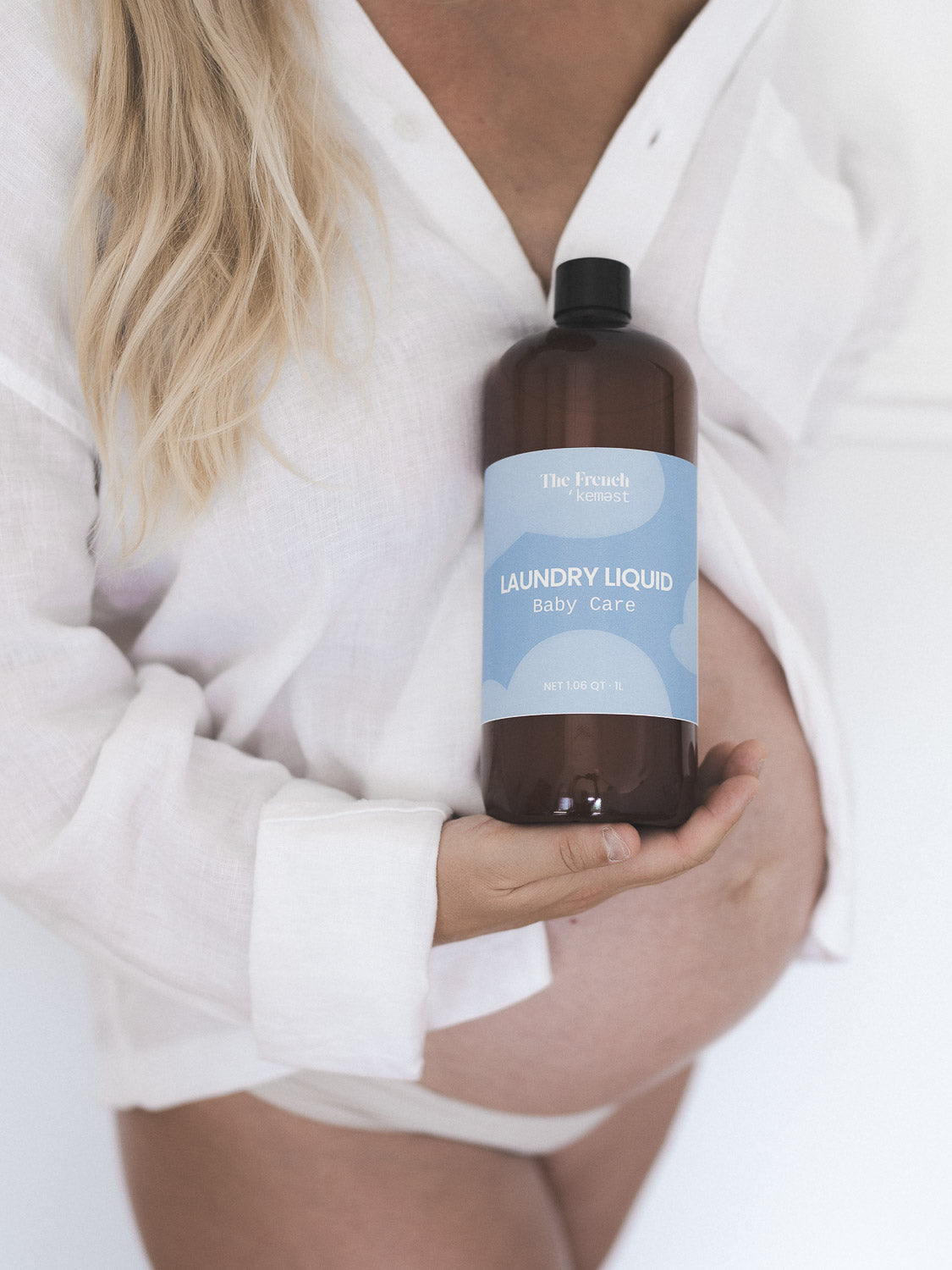
Here is the honest answer most baby-aisle packaging avoids: pediatric organizations in the United States generally say that a dedicated baby detergent is not necessary for most families. The American Academy of Pediatrics notes that many parents simply wash baby clothes with the rest of the family laundry without any problem. Nemours, one of the largest pediatric health systems in the country, says the same.
So why does the baby detergent aisle exist, and why are the bottles pastel? Because the question parents are really asking is legitimate, even when the marketing answer is not. The real question is not "does this bottle say baby on it" but "what will be left on the fabric that touches my child's skin all day."
That question has a factual answer, and it is about ingredients, not labels.
What actually matters for baby laundry
A newborn's skin barrier is thinner and more permeable than adult skin, and it is still maturing during the first months. Clothing, sleepwear, bedding, and burp cloths are in contact with that skin around the clock. What matters is what remains on the fiber after the rinse.
Three categories of ingredients deserve your attention.
Fragrance. Fragrance is the most common cause of skin reactions to laundry products. This includes synthetic fragrance blends and, less intuitively, essential oils, which contain naturally occurring allergens such as linalool and limonene. Pediatric guidance for sensitive skin consistently points in one direction: fragrance-free. Not lightly scented, not "baby scent," which is simply fragrance with different marketing. Fragrance-free.
Dyes and optical brighteners. These are cosmetic ingredients. Dyes color the detergent; brighteners are molecules designed to remain on fabric and reflect blue light so whites look whiter. Neither cleans anything, and both stay in contact with skin by design. A formula intended for baby textiles has no reason to include them.
Preservatives. Liquid detergents that need preservation commonly use isothiazolinone preservatives, which are effective in tiny doses and are also documented skin sensitizers for some individuals. Some formulas avoid the need for them structurally, which is worth understanding when you compare labels.
Notice what is not on this list: the word baby. A detergent can carry a teddy bear on the front and still contain fragrance, dye, and brighteners. A detergent designed for the whole family can be a better baby detergent than the baby detergent.
The four-ingredient approach
When we formulated our Baby Care laundry liquid, we did not start from a regular formula and remove things until it looked reassuring. We started from the minimum a detergent needs and stopped there:
Water, Potassium Sunflowerate, Sodium Carbonate, Sodium Chloride.
Water. A soap made from sunflower oil, which does the cleaning. Washing soda, which softens the water so the soap works well. And salt, which adjusts the texture of the liquid.
There is no fragrance of any kind, no dye, no brightener, and no added preservative: the natural alkalinity of a soap-based formula makes it an environment where microbes struggle to grow. Every ingredient is on the label, and every ingredient has a job you can name.
We say this not because a four-ingredient formula is the only defensible choice, but because it makes the comparison easy. Put any baby detergent's full list next to those four lines and you can see exactly what each brand decided your baby's laundry needs.
Practical answers to the practical questions
Do I need to wash baby clothes separately? Generally no, according to the AAP. If the whole household uses a formula suitable for sensitive skin, everything can go in together, which is simpler and uses fewer washes. The recognized exception is cloth diapers, which should be washed separately.
Should I wash new clothes before first wear? Yes. New garments have been handled, stored, and sometimes treated with finishing agents. One wash before first wear is a sensible habit for anything that touches a newborn's skin.
Liquid or powder? Pediatric sources tend to favor liquids for baby laundry because they rinse out more completely, leaving less residue in the fibers.
What about fabric softener and dryer sheets? Skip them for baby textiles. They work by depositing softening and fragrance ingredients onto fabric, which is precisely what you are trying to avoid. Line drying or dryer balls achieve softness without deposits.
What if my baby already has reactive skin? Choose fragrance-free and dye-free, rinse thoroughly, and consider an extra rinse cycle. If irritation persists or you suspect eczema or an allergy, talk to your pediatrician rather than cycling through detergents. Laundry is one variable among many, and a doctor can help you isolate it properly.
The short version
You do not need a bottle that says baby. You need a formula you can read: fragrance-free, dye-free, brightener-free, fully disclosed, and rinsed well. If that describes your regular detergent, your baby's clothes can join the family wash from day one. If it does not, the fix is not a second detergent for the baby. It is a better detergent for everyone.
FAQ
Is baby detergent different from regular detergent?
Often less than the packaging suggests. Some baby detergents are simply fragrance-free, dye-free versions of a standard formula; others still contain fragrance and brighteners. The label, not the word baby, tells you which one you are holding.
What laundry detergent do pediatricians recommend for babies?
Pediatric guidance focuses on characteristics rather than brands: fragrance-free, dye-free, well rinsed, with liquids often preferred over powders because they leave less residue. Any formula meeting those criteria is a reasonable choice.
Can I use the same detergent for the whole family?
Yes, and it is the approach the AAP describes as common practice. Choosing one sensitive-skin formula for the entire household is simpler than maintaining two detergents and ensures everything the baby touches, including your own clothes, is washed the same way.
When can I stop using special detergent for my baby?
If you use a single gentle formula for the whole family, the question disappears. There is no defined age at which skin stops preferring fewer residues; plenty of adults choose fragrance-free laundry for the same reasons.
Does fragrance-free mean the laundry will smell bad?
No. Clean fabric without fragrance smells like nothing, which is the point. Persistent bad odors after washing usually signal overloading, underdosing, or a machine that needs cleaning, not a missing perfume.
Sources
- American Academy of Pediatrics, HealthyChildren.org, "Cleaning Baby Clothes"
- Nemours KidsHealth, "Laundering Your Baby's Clothes"
- US FDA, "Fragrances in Cosmetics" (fda.gov)
- EU Regulation (EC) No 1223/2009, Annex III, fragrance allergen labeling (linalool, limonene)


